1 A $29 lot of four pens, and what it is really selling
The listing that set this off is an eBay lot titled something like "4 rare pharma merch pens": Xanax, OxyContin, Lexapro, Prozac. It is up for auction at $29, or $45 best offer. Nearby is a Lexapro mug at $49.99 with 13 watchers, and a "Lot of 3 mugs Xanax - Lexapro - Ultram" at $75, listed as "Brand New." We could not load these listings ourselves, so the figures are as they appeared on screen on October 10, 2026.
They sit about where you'd expect. Generic pharma pen lots ask far less. Five vintage pens (Tylenol ES, Vivactil, Abilify, Foradil, Fosamax) were listed at $19 in September 2026.19 Thirty mixed pens, marked "New," were listed at $19.50 or best offer.20 A lot of six (Ativan, Demadex, Coumadin, Pravachol and two others, "some work") actually sold for $12.15 So four pens for $29-45 is a premium, and the premium is the brand line-up: a benzodiazepine, an opioid and two antidepressants. A reseller interviewed by Antique Trader in 2025 named exactly those drug classes - painkillers, antidepressants, stimulants, sleep aids, benzos - as what buyers want.21 The one press-reported opioid-pen sale we found is a sealed two-pack of OxyContin pens at $79.99.21
The mugs follow the same pattern. Vintage Prilosec and Dyazide mugs were asking $38-42 on Etsy when we checked.22 A Lexapro mug at $49.99 is a psychiatric-brand markup over those, but 13 watchers is interest, not a sale, and we found no Lexapro mug sale to confirm the price holds. The "Brand New" three-mug lot is the most interesting of the three, because "Brand New" can mean two very different things. It can mean genuine new-old stock that never got handed out. It can also mean a modern print. A title can't tell you which; see the field guide at the end.
The obvious question is why a promotional mug for a prescription tranquilizer was ever made at all.
2 A century of free stuff, then a sales army that tripled
Drug-company gifts to doctors are old. A 2003 bioethics review put industry gift-giving at "almost a century."7 That undersells it. In Britain, Burroughs Wellcome was mailing doctors free handbooks from 1882 (about 25,000 copies) and annual ABC Medical Diary appointment books by 1890, plus blotters.23 The Wellcome Collection still holds the format: a 1909 pocket medical diary and visiting list with a buttoned flap, and the envelope that once carried a free sample of Wyeth's compressed chlorate of potash tablets.2425
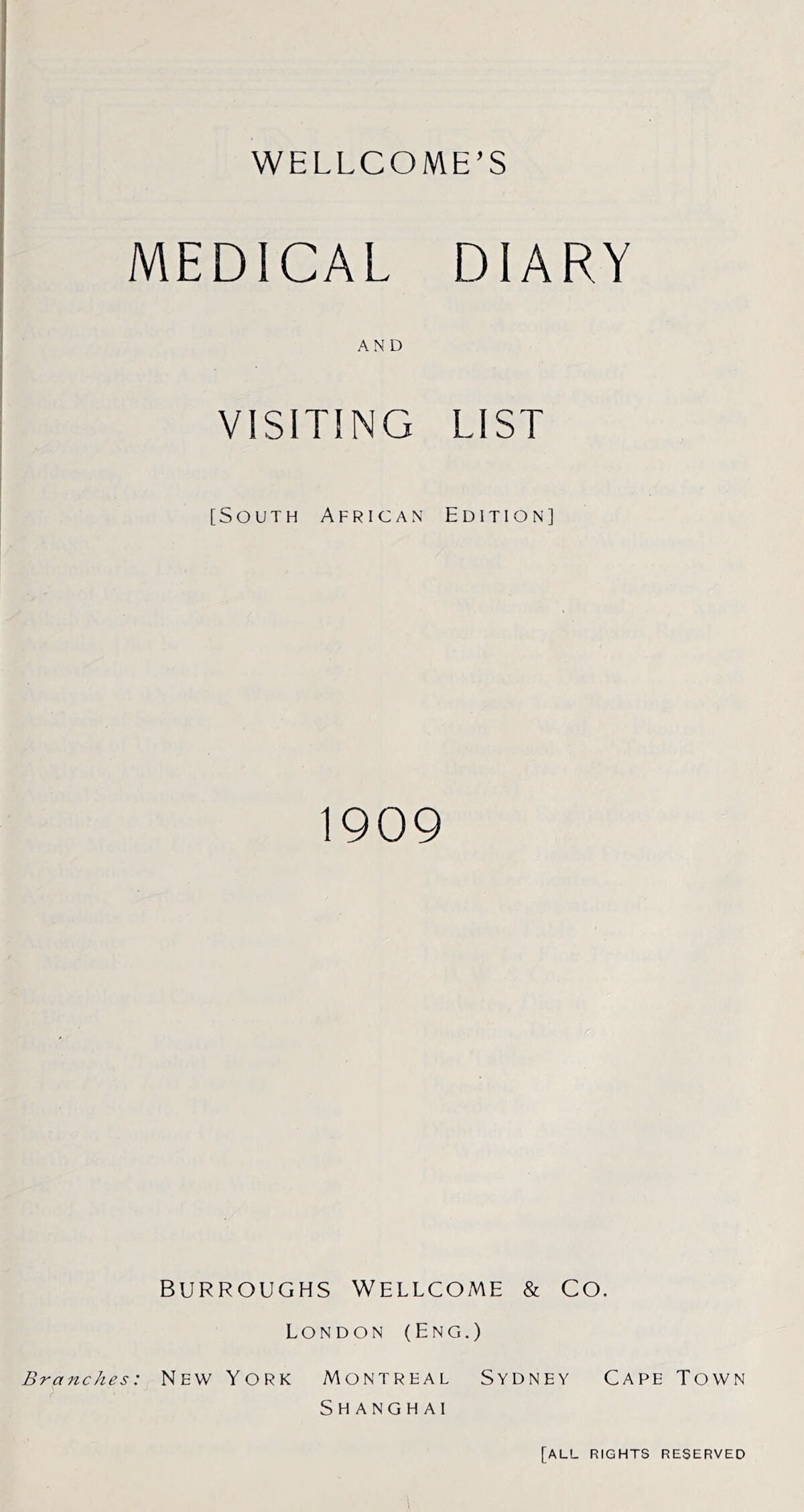 Wellcome's medical diary and visiting list, 1909Image hosted by Wellcome Collection - open the original ↗
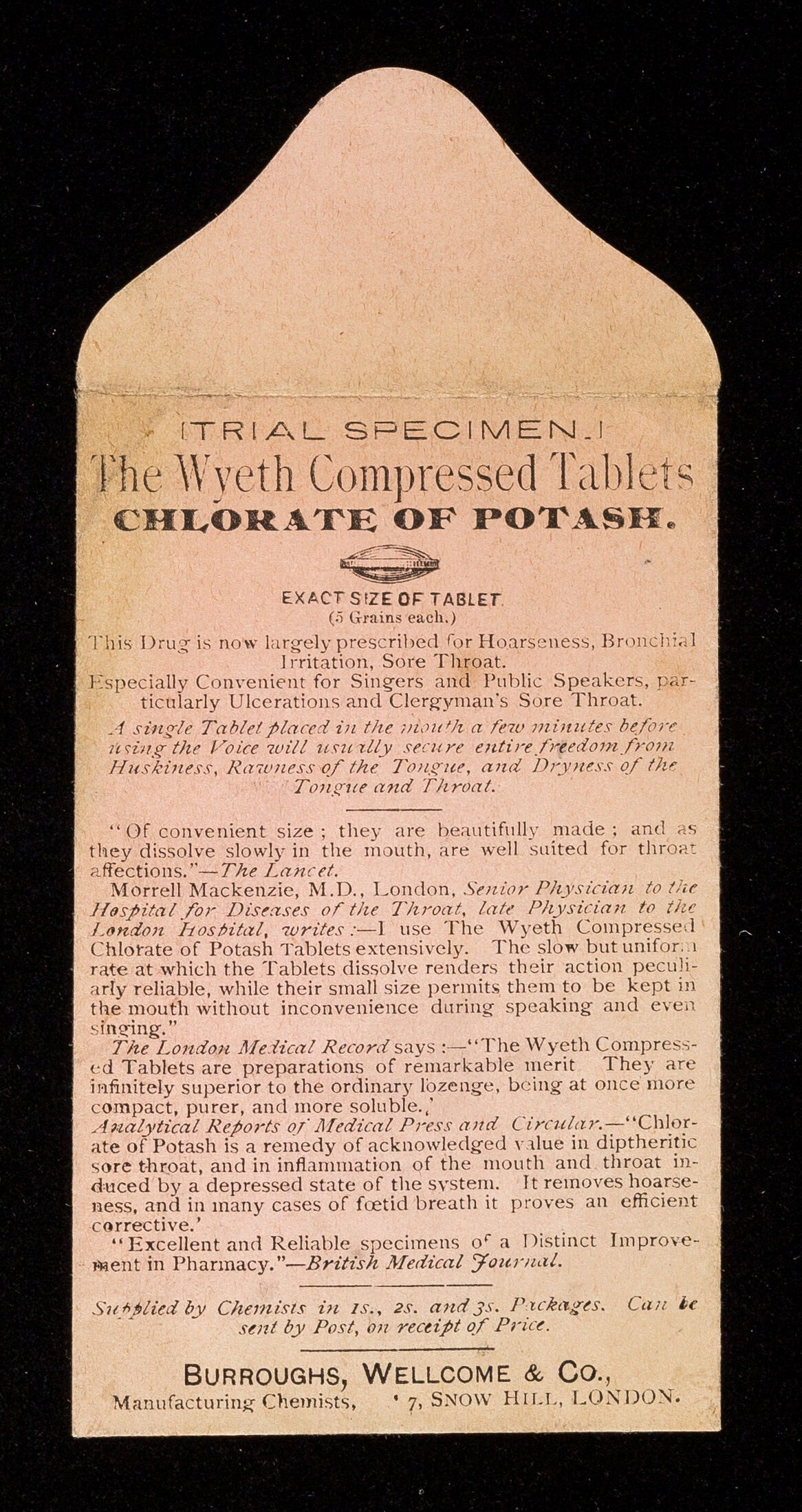 Trial specimen: the Wyeth Compressed Tablets Chlorate of Potash (c.1885-1900)Image hosted by Wellcome Collection - open the original ↗
The firm also understood the trade show. Its stand at the 1895 British Medical Association exhibition is an early, fully dressed example of drug marketing pitched at doctors in person, and by 1932 it was printing souvenir booklets for the BMA centenary meeting.2627
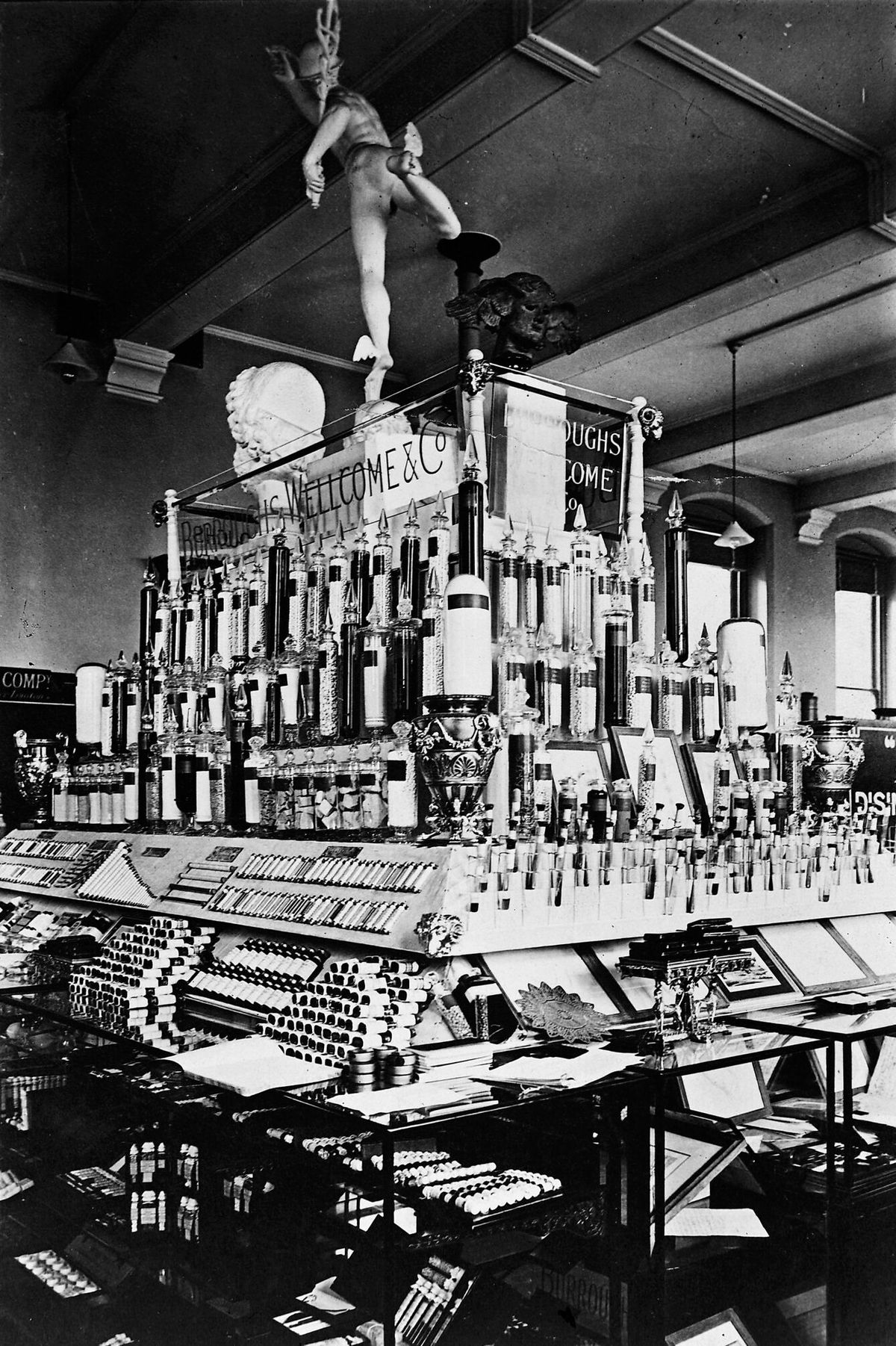 Burroughs Wellcome & Co stand at the British Medical Association Exhibition, 1895Image hosted by Wellcome Collection - open the original ↗
American evidence before 1960 is thinner but real, and it is mostly desk furniture. The Science History Institute holds a 1940s Roche-Organon blotter for Dimenformon tablets, styled as a prescription; blotters were giveaway advertising that soaked up fountain-pen ink, which is to say the pen's ancestor was the thing you used to clean up after the pen.28 The American Institute of the History of Pharmacy has a Parke-Davis blotter for "Emplets" enteric-coated tablets from about the same decade.29 Upjohn's archive at Western Michigan University holds the catalogs and price lists, 1893 to 1961, that its "Detail men" carried on visits to physicians and pharmacists.30 In 1954 Sharp & Dohme's advertising department made a limited-edition replica of Laennec's 1816 stethoscope as a doctor giveaway, now in the Smithsonian.31 Pfizer's late-1950s porcelain ashtray, with a dragon hiding the word "COSA" (its name for a line of potentiated antibiotics), is the period's best-known oddity, and Schering gave pharmacies a Coricidin mortar and pestle with each case ordered from 1963 to 2009, 44 sets in all.32 Coricidin was an over-the-counter remedy, so the mortars sit just outside the prescription story.
Mid-century promotion also leaned toward prestige objects: OHSU holds 1925-1965 Parke-Davis history-of-pharmacy prints and Frank Netter lithographs for Armour, and Duke holds nearly 90 years of one Mount Sinai gastroenterologist's swag, down to a tie clasp shaped like the GI tract.3334 Journal advertising got glossier too. A 1955 Poulenc insert from Montreal sold Largactil (chlorpromazine) and Phenergan to doctors in two-sided full color.35
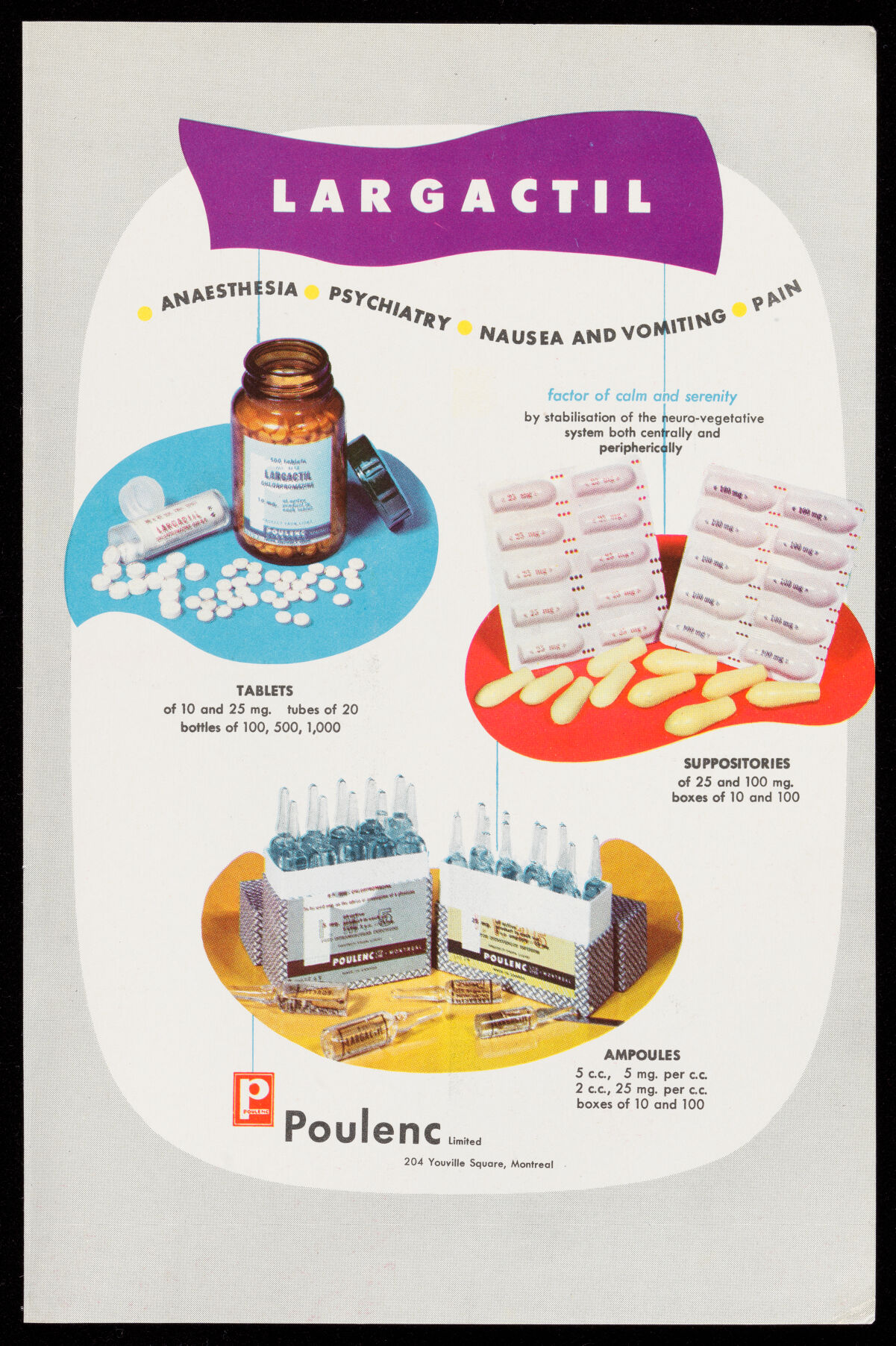 Largactil / Phenergan magazine insert advertisement (Poulenc, Montreal, 1955)Image hosted by Wellcome Collection - open the original ↗
The 1950s also brought the industry its first big congressional reckoning. Senator Estes Kefauver opened his drug-industry investigation in 1959, and President Kennedy signed the Kefauver-Harris Amendments on October 10, 1962, after thalidomide. "Companies spent millions of dollars to make Miltown and Diuril household names," as the AIHP puts it, though nobody seems to have counted the ashtrays.36
What changed in the 1980s and 1990s was scale. Lavish gifts and cash had become a public scandal by the 1980s, which pushed the AMA and the industry to adopt voluntary guidelines in 1990. Those capped gifts at $100 and specifically allowed pens and notepads.7 Then came the blockbusters. Eli Lilly began marketing Prozac, the first SSRI, in 1987, and it became for a time the "biggest selling drug in the history of the pharmaceutical industry."37 The rep force grew to match. IMS Health counted about 41,000 US reps in 1996, 50,500 in 1997 and 57,500 in 1998, a 39% jump in two years.4 By 2005 the count peaked at roughly 102,000, then fell to about 92,000 by early 2009.5 One 2006 estimate put the total at about 100,000, "almost triple" the figure of a decade earlier.6 More than 70,000 were still working in 2016.8 Counts vary with who is counting, so "roughly 35,000-41,000 in the mid-1990s, about 100,000 at the 2005 peak" is the honest range.
The sales army that handed out the pens
US pharmaceutical sales representatives, cited counts only.
No source we found measures swag volume directly. It is a reasonable inference, though, that the trinket supply tracked the rep supply, which would put the peak somewhere between the late 1990s and 2008.
3 Cheap objects, expensive logic
The pens were never the money. Schwartz and Woloshin's 2019 JAMA accounting put total US medical marketing at $17.7 billion in 1997. Of that, $15.6 billion went to health professionals, and free samples alone were worth $8.9 billion at retail value. Detailing (rep visits) ran about $5 billion a year in both 1997 and 2016.8 Gagnon and Lexchin, using a broader method, estimated total US promotion at $57.5 billion in 2004, about 1.8 times industry R&D.38
Against those figures, promotional products were small. Drug makers spent about $630 million on promotional products in 2007, roughly 3% of the $19.6 billion US ad-specialty market.39 The promo industry estimated the 2009 ban would cost it up to $1 billion, about 5% of its annual income.139 Dard Design drew about a quarter of its $50 million in sales from drug makers.39 When the ban came, one Brand Fuel executive called it "a swift punch to the gut."39
So why bother with pens at all? Partly it is reminder advertising: the brand name sits on the desk at the moment of prescribing. Mostly it is reciprocity. The 2003 review cites Robert Cialdini's rule that a gift "imposes on the recipient an obligation to repay." It notes that this obligation is "not related to the size of the initial gift." It also cites a pharmacy that handed out $0.50 key chains at the door and saw purchases rise 17%.7 The same review quotes a finding from 1995 that is hard to improve on: "the more gifts a physician receives, the more likely he or she is to believe that they do not influence behavior."7
4 A design system built from the pill itself
Pens were the everyday item. Every account of the 2009 ban leads with them, and writing instruments were the second-largest promo category industry-wide.39 Our directory reflects this: pens are the largest single type, about 150 of the roughly 440 entries. That is partly because pens really were the cheapest and most common giveaway. It is also survivorship bias, since pens are what turns up in thrift-store bags and eBay lots. Around the pens sat the rest of the office. The New York Times story on the ban, as summarized at the time, listed branded bandages, tongue depressors, stethoscopes, calipers, mugs, prescription pads, soap dispensers and T-shirts. It specifically named Viagra pens, Zoloft soap dispensers and Lipitor mugs.140
The better pieces treat the pill itself as the logo. Pfizer had a silk tie printed with blue "VIAGRA" tablets made for Louis Ignarro, the Nobel laureate whose nitric-oxide research underpinned the drug. Ignarro gave it to the Nobel Prize Museum, where it is catalogued as item 2017.011.003.41 Wyeth-Ayerst made Premarin letter openers whose Lucite handles were embedded with real tablets in all five strengths.42 AstraZeneca, which has defended the Nexium purple as a trademark in court,43 put the "purple pill" on mugs and on a 12-inch pill-shaped thermos, both documented here from listing titles.44 Purdue made a roughly 10-inch plush OxyContin 80mg tablet, blue-green with white hands and feet. Its banner reads "WARNING- MAY BE HABBIT FORMING," misspelling included, and its toy tag is dated 1995.45
A second strand gave each item a job related to the drug. Merck's Cozaar/Hyzaar blood-pressure set came with a cuff and the slogan "TAKE IT DOWN."46 Boehringer's Mobic, an arthritis drug, came as a femur-shaped pen.47 TAP's Prevacid came as a stomach-shaped beanie plush.48 Immunex's Enbrel, an injectable, became a syringe-shaped highlighter.49 Smith Kline & French put eighteen Thorazine dosage forms on a 12-inch metal ruler, which is either very practical or a reminder that the 1960s had different ideas about desk decor.50 Pfizer's Feldene came as a chrome reflex hammer.51 A 2007 science blog rated a Flonase plush "stuffed nose" with arms and legs and an Eli Lilly Magic 8-ball whose every answer flattered the company.52
Then the mascots. Novartis's Lamisil campaign starred "Digger the Dermatophyte," a yellow, pointy-eared nail-fungus creature from Deutsch NY that launched April 12, 2003.53 Digger became a bobblehead that doubles as a business-card holder, with the cards slotting into a Lamisil tablet on his head.54 SmithKline's 1988 heartburn program produced "Tagamet Tommy," a five-inch bendable figure.32 Fleet produced "EneMan," an eight-inch plush doll shaped like an enema, which really exists, and which the Smithsonian has (see below).425556 Zyrtec had a purple gorilla plush, known only from a listing title.57
The famous one doesn't hold up as well. Pfizer's Zoloft "blob," the sad oval from the Deutsch campaign that started in May 2001, is widely remembered as a plush toy.58 No source we reached confirms that Pfizer ever made an official promotional Zoloft blob plush. Two rounds of searching turned up unrelated blob-seal plushies and recent fan-made pill plush on Etsy.5960 The only blob merchandise we could verify is a black two-sided promotional T-shirt dated 2001, with a sad blob on the front and a happy blob on the back.61 The plush may exist. We can't show it does.
The Smithsonian has a swag drawer
The strongest proof that this stuff was real, and not a shared hallucination of everyone who worked in a clinic in 1999, is that the National Museum of American History catalogued it. Its medicine and science division holds Fleet's EneMan as both a wall clock and a plush promotional doll, each dated around 1999.6256 It holds a Lexapro advertising tissue box from about 2002, which is either tone-deaf or perfectly on message for an antidepressant, depending on your mood.63 It has a handheld Prozac Weekly maze puzzle from Lilly, a Viagra pill necktie, and a Merck Sharp & Dohme head model with a removable half-skull, made around 1974 to sell the antidepressant Elavil.646566 There is a 1960s Ciba advertising figure for Ritalin and a small plastic statue for Merck's Diuril and HydroDiuril diuretics.6768 And there are pens: a Searle Flagyl pen from about 1983, a 1996 Aerobid inhaler pen, a Concerta pen with a bubble wand built in, and Syntex's Tri-Norinyl pen, "The Shape of Things to Come."69707172
The museum's own photographs come with reuse restrictions, so we link out to them rather than reproduce them. The cards below go straight to each catalogue record.
The swag drawer at the Smithsonian (and friends)
23 real objects held by museums. Tap through to see each one.
- Fleet EneMan Clock (c.1999)A promotional clock from Fleet Pharmaceuticals featuring its 'EneMan' enema mascot.Smithsonian NMAH ↗
- Fleet EneMan promotional doll (c.1999)A plush promotional doll of Fleet Pharmaceuticals' EneMan mascot, made with Swann Group.Smithsonian NMAH ↗
- Lexapro advertising tissue box (c.2002)A branded tissue box advertising the antidepressant Lexapro, made by Forest Pharmaceuticals.Smithsonian NMAH ↗
- Prozac Weekly promotional maze (c.2000)A handheld promotional maze puzzle from Eli Lilly for Prozac Weekly.Smithsonian NMAH ↗
- Viagra Pill NecktieA promotional necktie decorated with Viagra pill illustrations.Smithsonian NMAH ↗
- Elavil (amitriptyline) advertising head model (c.1974)A Merck Sharp & Dohme anatomical head model with a removable skull half, used to advertise the antidepressant Elavil.Smithsonian NMAH ↗
- Ritalin advertising figure (c.1960s)An advertising figure for Ritalin (methylphenidate) made by Ciba.Smithsonian NMAH ↗
- Diuril / HydroDiuril advertising statue (after 1959)A small plastic advertising statue for Merck's Diuril and HydroDiuril diuretics.Smithsonian NMAH ↗
- Merck Sharp & Dohme ashtray (c.1960)A ceramic promotional ashtray made for drug firm Merck Sharp & Dohme.Smithsonian NMAH ↗
- Searle Flagyl promotional pen (c.1983)A promotional pen from G. D. Searle advertising the antibiotic Flagyl.Smithsonian NMAH ↗
- Aerobid/Aerobid-M advertising pen (1996)An advertising pen for the asthma inhaler Aerobid, made by Forest Pharmaceuticals.Smithsonian NMAH ↗
- McNeil/Alza pen and bubble wand, advertisement for Concerta (c.2000)A plastic pen with a bubble wand advertising the ADHD drug Concerta.Smithsonian NMAH ↗
- Syntex Tri-Norinyl 'The Shape of Things to Come' promotional penA promotional pen from Syntex for the Tri-Norinyl oral contraceptive.Smithsonian NMAH ↗
- 'The Boring O.C.' Norinyl 1+35 promotional tileA promotional tile from Syntex advertising the Norinyl 1+35 oral contraceptive.Smithsonian NMAH ↗
- Laennec stethoscope replica, limited edition by Sharp & Dohme (1954)A limited-edition replica of Laennec's 1816 monaural stethoscope, made by Sharp & Dohme's advertising department as a doctor giveaway.Smithsonian NMAH ↗
- Burroughs Wellcome Physicians Gift SamplerA boxed physicians' gift sampler from Burroughs Wellcome, catalogued as an advertising device.Smithsonian NMAH ↗
- Merck knee joint model (c.1962)A plastic anatomical knee model made by Merck as a drug advertising device.Smithsonian NMAH ↗
- Viagra Sample Tablets 50 mg (c.2002)A professional sample pack of Pfizer's Viagra 50 mg tablets.Smithsonian NMAH ↗
- Zoloft Starter Kit (c.2003)A Zoloft starter kit, a sample pack distributed to prescribers.Smithsonian NMAH ↗
- 'Birth Ritalin Prozac Viagra Death' buttonA square metal button that satirises a life lived on brand-name drugs.Smithsonian NMAH ↗
- Carton of four Viagra (sildenafil citrate) tablets, 50 mg, Pfizer, Sandwich, England, c.1998A Pfizer carton holding four blue 50 mg Viagra tablets.Science Museum Group ↗
- Carton of 30 Prozac capsules, Eli Lilly, England, 1993A carton of 30 Prozac (fluoxetine) 20 mg capsules made by Eli Lilly in Basingstoke.Science Museum Group ↗
- Ballpoint pen advertising Timentin, 1985-1990A black ballpoint pen with white lettering advertising the antibiotic Timentin.Science Museum Group ↗
Two things stand out in that drawer. The first is how early the anatomical-model habit started: Elavil's head and Diuril's statue predate the pen boom by decades, and the 2009 code would later carve out "educational" anatomical models as the one kind of branded object still allowed.3940 The second is that the curators saved exactly what eBay sells: the same Prozac Weekly maze is listed sealed at $50 asking, and a Lexapro tissue box cover at $49.50.7374 The museum and the resale market agree on what mattered.
5 Who got the stuff: doctors, and the people guarding doctors
Physicians met reps about four times a month, according to Wazana's 2000 review.75 The swag had a wider audience than doctors, though. Reps courted "gate-keepers like receptionists or nurses" with office lunches, and they delivered "dine and dash" takeout for the doctor's family.76 Rep trainers had a name for front-desk staff: "SPOs," or Sales Prevention Officers.2 The 2009 code's ban expressly covered professionals "and their staff."11 We read that as the industry acknowledging who used the pens, clocks and notepads every day, though that is our inference.
 Doctor's office. Dover, Delaware (1938)Image hosted by Library of Congress - open the original ↗
Medical students were a market too, and they were the first to push back. The American Medical Student Association's PharmFree campaign started in 2002. Its members left thousands of Pfizer-logo pens on the doorstep of Pfizer's New York offices, and student volunteers made "counter-detailing" visits to some 40,000 physicians.7778
The best counter-move came from one internist. Bob Goodman, a Columbia physician, opened a Washington Heights clinic closed to reps in 1999 and started No Free Lunch, which asked doctors to pledge off gifts and sold its own branded pens and mugs.79 (The Christian Science Monitor and Wikipedia date the group to 2000; Mother Jones implies 1999 for the website. Pick your year.)78 Then he ran what Psychology Today called a "pen amnesty."80 The mechanics were simple: a doctor mailed in their drug-company pens, and Goodman mailed back a few No Free Lunch pens, so the desk still had something to write with and the logo now said the opposite. "It's a money loser," he told Mother Jones in 2003, but "it's a fun way to spread the word." By then well over 1,000 pens had been surrendered, the site drew about 300 visitors a day, and more than 200 people had signed the pledge.79 A year later Psychology Today described thousands of branded pens piling up in his office and about 350 doctors and students pledged.80 This site is named for it.
File for pen amnesty
No Free Lunch's real amnesty ran by mail. Ours runs in your browser, collects nothing, and still issues paperwork.
Conventions were where the rules slipped most. At the 2002 APA meeting, Public Citizen observers logged 16 exhibit-rule violations across 24 drug booths. They included toy and stuffed-animal giveaways, CDs, personalized luggage tags, Palm Pilot cases and mugs in velvet bags.81
6 Does a pen work? The evidence says it might, and that's enough
The best experiment on the pens themselves is Grande and colleagues' 2009 study. They randomized 352 third- and fourth-year medical students at Miami and Penn, exposed some to a Lipitor-branded clipboard and notepad at sign-in, and then measured implicit attitudes toward Lipitor versus Zocor. Miami fourth-years who saw the items favored Lipitor more. At Penn, which had restrictive marketing policies, the effect reversed, and the exposed students favored Lipitor less.82 The effect is real, small and shaped by context: in a skeptical culture, the logo seems to backfire.
The evidence on real prescribing comes mostly from meals, not trinkets. DeJong and colleagues matched 2013 Medicare Part D data to Open Payments meal records. A single sponsored meal, averaging under $20, was associated with more prescribing of the promoted brand. Four or more meal days were associated with about twice the Crestor prescribing and more than five times the Bystolic. The design is correlational.83 A 2017 study of about 2,900 DC-area prescribers found gifts of any size associated with more brand-name and high-cost prescribing.84 In JAMA in 2003, Dana and Loewenstein argued that influence runs through unconscious self-serving bias, and that "the sheer ubiquity of trinkets... is evidence of their effectiveness."85 Put plainly, companies don't spend $630 million a year on something that does nothing.
Our honest verdict: we found no study linking a pen or mug alone to actual prescribing outcomes. What exists is good evidence that small gifts and contact shift behavior, an experiment showing that logo exposure shifts attitudes, and an industry that clearly believed it. The 2009 code didn't wait for proof either. PhRMA justified the ban by saying reminder items "may foster misperceptions."86
7 The end, in two acts: 2002 spared the pens, 2009 killed them
Act one was PhRMA's first Code on Interactions with Health Care Professionals, in effect from July 1, 2002. It ended tickets, golf outings, lavish dinners and cash. But it expressly permitted pens, notepads and similar logo items "primarily associated with a health care professional's practice," and it allowed occasional items worth up to $100 that mainly benefited patients.96 Paradoxically, this probably made the 2002-2008 years the high point for ordinary desk trinkets, because they were among the few gifts still allowed. That is our inference, and nobody has measured it.
Act two came on July 10, 2008, when the PhRMA board unanimously adopted a revised code effective January 2009.10 It barred non-educational items "even if those items are given to healthcare professionals for patient use."10 A law-firm alert summed it up in its headline, "What, No More Pens?", and noted that "there is no de minimis exception."11 The banned list named "pens, notepads, coffee mugs, and wall clocks."86 All 32 PhRMA members and 9 non-members signed on.39 The reactions were good. Dr. Daniel Carlat called the changes "completely cosmetic." Dr. Thomas Stossel said: "If I never see another Pfizer mug or Merck pen, I don't care."86 The promotional-products trade group's Steve Slagle objected that "putting office tools and logoed items in the same category as junkets and banquets makes no sense."3 NPR ran it as "No More Free Pens for Doctors."87 The Times ran "No Mug? Drug Makers Cut Out Goodies for Doctors."1 Educational items such as anatomical models up to $100 survived.4039 Device makers followed: AdvaMed's revised code, effective July 1, 2009, banned branded pens, notepads and mugs "even if nominal in value."88
Some institutions moved earlier. Yale's policy took effect in 2005, Penn's in 2006, and UC Davis barred samples, pens, mugs and meals from July 2007.89 A 2006 JAMA proposal urged academic medical centers to ban gifts outright.89 In January 2008 a Minnesota health system pulled more than 18,000 branded items from its clinics, filling 20 shopping carts.90 AMSA's 2008 scorecard still gave 60 of 150 medical schools an F.91
Vermont, Minnesota and the Sunshine Act
Minnesota went first among the states in 1993 with a $50 gift cap.92 Vermont required disclosure of gifts over $25 from 2002.7 Its Act 59, effective July 1, 2009, banned gifts from manufacturers of prescribed products outright, while still allowing samples and patient education materials.93
Federal transparency came later and aimed elsewhere. The Physician Payments Sunshine Act is Section 6002 of the Affordable Care Act, signed March 23, 2010. Payments under $10 were exempt unless one company's total to a recipient reached $100 in a year; penalties ran up to $10,000 per failure to report and $100,000 per knowing failure.94 The thresholds are now indexed to inflation: for 2026 the floor is $13.82 per item and $138.13 a year.95 Data collection under Open Payments began August 1, 2013, and the first public data went online September 30, 2014.9697 A pre-2009 pen would have sailed under that floor anyway (our arithmetic). The Sunshine Act mostly exposed meals, speaking fees and consulting payments. In 2016, $164 million of drug makers' non-research payments to physicians went to food and beverages.8
The rest of the world caught up
Other countries followed, more slowly than the folklore suggests. Australia banned brand-name reminders "ordinarily used outside the surgery" from January 1, 2010.98 The UK's ABPI code banned promotional aids for health professionals from January 1, 2011, with a transition period to April 30, 2011, though inexpensive pens and notebooks handed out at meetings stayed allowed.99 Europe's EFPIA ratified its ban in June 2013 and it applied from January 1, 2014; pens, sticky notes and USB sticks were out, and only inexpensive informational items or items of "medical utility" survived.100101 That resolves a question we left open in our first version: the European ban did take effect as planned, over the European promo-products association's insistence that trinkets "have no influence at all."102 IFPMA's global code finished the job from January 1, 2019, with one exception: pens and notepads not branded with a product, at company events.103 We still could not date Canada's ban.104 The UK code body now says simply that "product branded items were stopped many years ago."105
8 OxyContin: the swag that became evidence
The most thoroughly documented swag program in American history belongs to the drug that did the most damage. In December 2003 the Government Accountability Office reported on Purdue Pharma's OxyContin marketing. Purdue grew its sales force from 318 reps in 1996 to 766 in 2001, plus about 300 Abbott co-promotion reps. Its call lists grew from about 33,400-44,500 physicians to roughly 70,500-94,000. Sales climbed from $44.8 million in 1996 to $1.54 billion in 2002.17 In 2001 the average rep earned a $55,000 salary plus a $71,500 bonus.17
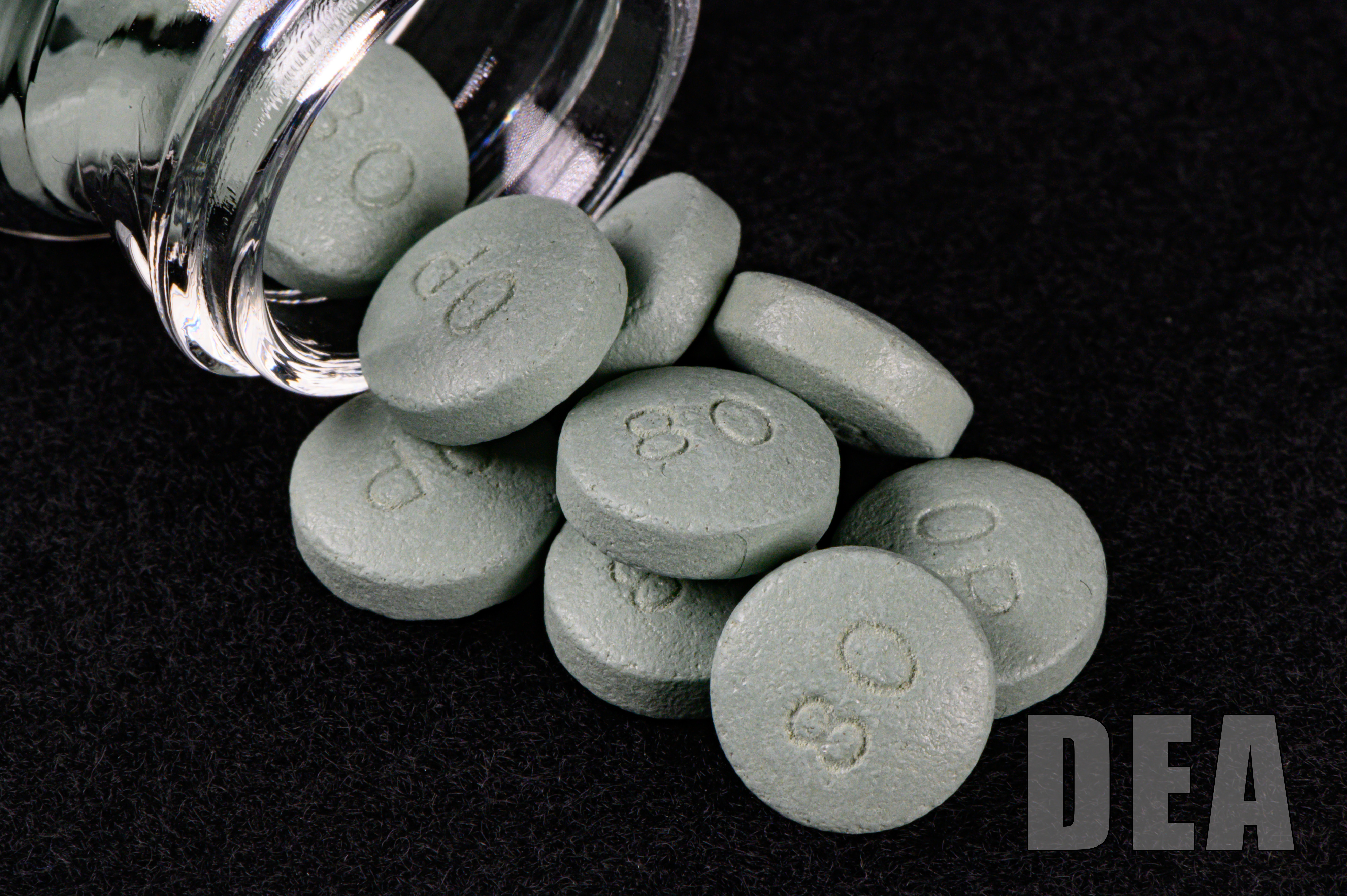 OxyContin 80 mg tablet (DEA reference image)Image hosted by DEA - open the original ↗
In the middle of all those numbers, the GAO lists the merchandise: "OxyContin fishing hats, stuffed plush toys, coffee mugs with heat-activated messages, music compact discs, luggage tags, and pens with a dose-conversion chart."17 The DEA called branded promotional items for a Schedule II opioid unprecedented. In May 2002, Purdue told its reps to destroy any remaining "non-health-related" items, such as stuffed toys and golf balls.17 The GAO gives no motive. The timing lines up with the PhRMA code that took effect that July, which is our inference.9 After the purge Purdue moved to clinical-looking items, including a branded goniometer for measuring range of motion.17
John Oliver did two separate segments that matter here, and they often get merged. The first, "Marketing to Doctors," opened Last Week Tonight's second season on February 8, 2015; it covered free lunches and "thought leaders" and told viewers to look up their own doctors in Open Payments.106107 The second, on opioids, aired October 23, 2016, and used OxyContin swag as props: swing-music CDs, fishing caps and a plush gorilla held up as a mascot.108109 Readers then sent STAT their keepsakes. They included a heat-change mug reading "The One to Start With" that turned to "The One to Stay With" when hot; a windshield sunshade promising "The longest-lasting oxycodone ever"; a multi-tool; the fishing hat; a swing-music CD; and a stuffed gorilla in a blue OxyContin T-shirt.110 Oliver called the gorilla the perfect mascot, because OxyContin "might seem appealing, but if you are not careful it will tear your (expletive) life apart."110 The same haul turned up a Percocet mug that changes from "Pain" to "Relief" and a Vicodin fanny pack, whose seller said most "were probably given to their kids."110 Abbott's co-promotion reps, STAT reported separately, delivered doughnuts and snack cakes spelling out "OxyContin."111
Two details need care. The CD is often quoted by a formal album title, which is shaky. Art Van Zee, the Virginia physician whose 2009 American Journal of Public Health paper is usually cited for it, showed the CD in a 2020 Vanderbilt lecture: his slides give its slogans as "SWING IS ALIVE" and "Swing in the right direction with OxyContin," and give no title.112113 Fierce Pharma's 2014 roundup uses the second slogan too.114 The safest description is a swing CD branded "Swing in the right direction with OxyContin." Versions like "Get in the Swing with OxyContin" have no source we could find. The same slides call the hats "OxyContin Beach Hats - for physicians," where the GAO says "fishing hats."11217 Those are probably the same hat with two names, which is inference.
9 Boston, where the pens became illegal
Everywhere else in America, the 2009 pen ban was a promise an industry made to itself. In Massachusetts it was a law with a fine attached, and the state got there with less consensus than the outcome suggests.
 State House and Capitol, Boston, MassachusettsImage hosted by Library of Congress - open the original ↗
Chapter 305 and the regulation that names the pen
The statute is Chapter 305 of the Acts of 2008, "An Act to Promote Cost Containment, Transparency and Efficiency in the Delivery of Quality Health Care." Governor Deval Patrick signed it on August 10, 2008, a month after PhRMA's board voted for its voluntary code. Section 14 inserted a new chapter into the General Laws, M.G.L. c. 111N, "Pharmaceutical and Medical Device Manufacturer Conduct."12115 It almost didn't include a gift ban. The House version stripped it out in July 2008, and it went back in during conference.116 One trade blog's headline from the Senate stage that spring read "Doctor - Two year prison sentences for that pen," which captures the mood if not the final text.117
Here is a detail the first version of this piece got slightly wrong: the statute itself never mentions pens. Chapter 111N bans entertainment and recreational items, cash and cash equivalents, and meals that come with entertainment or without an informational presentation; it requires public disclosure of benefits of $50 or more; and it lets the Attorney General, district attorneys or the Department of Public Health seek fines of up to $5,000 per transaction, occurrence or event.12 The pen lives in the regulation the statute told DPH to write. 105 CMR 970.008(1)(b) prohibits "tangible items including any 'complimentary' items such as pens, coffee mugs, gift cards."13 The Public Health Council voted for the final rule unanimously, and DPH released it on March 11, 2009.118 Under 105 CMR 970.005, every manufacturer selling into the state had to adopt a marketing code, train its people, certify compliance and name a compliance officer by July 1, 2009, six months after PhRMA's voluntary ban, and register annually with a $2,000 fee.14119 Pew described the result as a mandatory code at least as strict as PhRMA's and AdvaMed's.92 That makes Massachusetts arguably the first place in the country where a branded pen in a doctor's cup carried legal risk, though "first" is our framing.
The law was unpopular with the people who had to live next to it. A 2010 House effort to repeal it was considered a long shot.120 PolicyMed headlines report that all of that year's gubernatorial candidates backed repeal and that the House voted "overwhelmingly" to repeal in April 2011; we saw the headlines, not the stories.121122 Restaurateurs, who had lost the pharma dinner trade, joined the lobbying.123 What finally passed was narrower. Governor Patrick signed an amendment on July 8, 2012 as part of the fiscal 2013 budget: it allowed "modest meals and refreshments" at non-CME educational presentations, including in restaurants, with quarterly reporting, and dropped state reporting that duplicated the new federal Sunshine data.124125 When the Public Health Council wrote the rules that November, it left "modest" undefined and allowed alcohol; motions to cap meal spending or ban drinks never got a vote.126 "Most of the restrictions of the original law remain in place," one law firm noted.124 The pen and mug language is still in the current text of 970.008, which strongly implies it survived untouched; no source says so in as many words.13 We also found no public record of any fine ever being issued under the chapter. That may mean compliance or nothing at all.
The first disclosure: who paid whom in the second half of 2009
The law's disclosure side produced Boston's first look at the money. The initial release, on November 23, 2010, covered July 1 to December 31, 2009: by MassDevice's count, $16.6 million from 161 companies to 3,326 physicians, with Boston Scientific the biggest payer at $2.54 million.127 MM&M counted 283 manufacturers and about $18 million in "bona fide services," and found the top individual recipient was a Cambridge doctor paid $194,275 by Genzyme.128 The two counts don't match and we have not reconciled them. DPH still hosts a searchable database of the filings from 2009 to the present.129 None of it records a pen, because by then nobody could give one.
The schools and hospitals got there first
Several Boston institutions banned the swag before the state did. Boston University Medical Campus announced its policy on September 10, 2007, "effective immediately": no pharma gifts, no rep contact with students and residents, no industry-paid meals on campus.130 Harvard Medical School was slower and more embarrassing about it. It drew an F on AMSA's conflict-of-interest scorecard, one of 34 schools so graded, with a policy last revised in 2004.131 On October 16, 2008, about 200 students rallied on the school's steps for a "pharm-free pledge," against a counter-group, the Benjamin Rush Society, that claimed more than 100 members.131 Harvard opened a review in March 2009, and in July 2010 adopted rules for its roughly 11,000 faculty: no promotional speaking, no personal gifts, meals or travel from industry, public reporting of payments of $5,000 or more, and a ban on marketing signs in the bathrooms.132
Partners HealthCare, now Mass General Brigham, announced in April 2009 that it would ban gifts, entertainment and food, including meals, along with paid promotional speaking, effective October 1, 2009, across Massachusetts General, Brigham and Women's, Spaulding and its other hospitals. Device reps would need a written invitation, and samples had to go through hospital pharmacies.133 At least one Brigham allergist resigned rather than give up paid speaking.128
Healey v. Purdue: the reps came back with coffee
The OxyContin story has a Boston chapter, and it is less about plush toys than about access. Attorney General Maura Healey sued Purdue Pharma in Suffolk Superior Court on June 12, 2018, and Massachusetts became the first state to name members of the Sackler family and Purdue executives as individual defendants.134135 The suit cited more than 670 Massachusetts overdose deaths since 2009 among people who had Purdue prescriptions.135
The amended complaint, filed January 31, 2019, is the closest thing we have to a swag ledger for the post-trinket era. It alleges Purdue reps made more than 150,000 visits to Massachusetts prescribers and pharmacists after 2007, and that the company gave meals, money or other gifts to more than 2,000 Massachusetts prescribers, rewarding high prescribers with coffee, ice cream, catered lunches and cash. It describes a list of about 100 top targets and one physician paid more than $80,000.18 The unredacted version, released that month, added that Richard Sackler went on ride-alongs with reps, and that one rep was ordered to raise prescriptions by 62%.136 Notably, the complaint names no fishing hats and no gorillas. Purdue had ordered those destroyed in 2002, and the visits that mattered later were bought with food and attention, not logo merchandise. That reading of the timeline is ours.17
Purdue's money was also inside Boston's medical institutions. It gave Massachusetts General Hospital $3 million in 2002 for the "Massachusetts General Hospital Purdue Pharma Pain Program," and staff noted it "gave Purdue name recognition among medical students, residents, and the public."137138 The Sacklers funded a Tufts master's program in pain research in 1999.138 The case itself was folded into Purdue's bankruptcy. A July 2021 deal valued at $4.3 billion was to send Massachusetts about $90 million and force document disclosure; Healey said it made the Sacklers "turn over their secrets."139 In January 2025, Attorney General Andrea Joy Campbell announced a $7.4 billion national deal, with up to $108 million for Massachusetts.140 We did not confirm the final plan's status or the exact Massachusetts payout.
Two schools, two decisions about a name
On December 5, 2019, Tufts removed the Sackler name from its health sciences campus, effective immediately. The Sackler School of Graduate Biomedical Sciences became the Tufts Graduate School of Biomedical Sciences, and the Arthur M. Sackler Center for Medical Education became the Tufts Center for Medical Education. An outside review by Donald K. Stern and Sandy Remz had found $15 million in donations from Purdue and the Sacklers, without recommending a renaming; Tufts did it anyway and set up a $3 million addiction-research endowment.141 Across the river, Harvard went the other way. In July 2024 its governing Corporation accepted a committee's finding that a petition to rename the Arthur M. Sackler Building and Museum "did not meet the standard for denaming," noting that OxyContin was introduced nine years after Arthur Sackler's death.142143 Together they mean a Boston medical student can walk past one Sackler name and not the other.
Local product: Lunesta, and an ancestor in Lowell
Boston's own contribution to the swag era came late. Sepracor, based in Marlborough, launched the sleeping pill Lunesta after its approval in December 2004 with a $60 million campaign, mostly late-night television, and 1,250 sales reps, pricing it about 75% above Ambien.144 The name is lunar plus siesta.145 By 2008 Lunesta was nearly half of Sepracor's $1.29 billion revenue, and in 2009 Dainippon Sumitomo bought the company for about $2.6 billion.146 Lunesta's brief window inside the gift era left a modest trail: a blue "page pal" paperweight and a set of Lunesta pens, both known only from listing titles.147148 We found nothing reliable for Genzyme, Biogen or Millennium.
The deeper local ancestor is in Lowell. In the 1880s J.C. Ayer & Co. flooded the country with chromolithograph trade cards for Ayer's Sarsaparilla and Ayer's Cherry Pectoral - an invalid in a garden with a bottle, a young woman with a basket of cherries.149150 They were patent medicines advertised to the public, not prescription drugs pitched to doctors, so the line from Lowell to a 1998 Lipitor mug is a family resemblance rather than a pedigree. But the instinct is the same: put the brand on a small, pretty, free object and let people keep it.
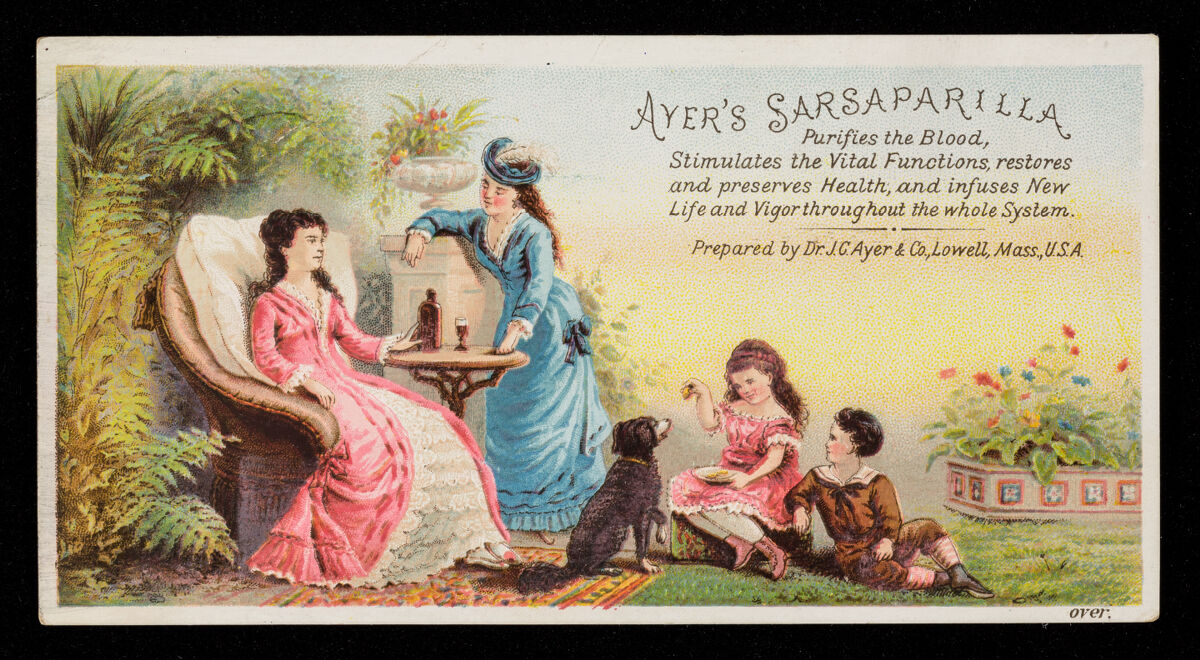 Ayer's Sarsaparilla trade card (Dr. J.C. Ayer & Co., Lowell, Mass., 1880s)Image hosted by Wellcome Collection - open the original ↗
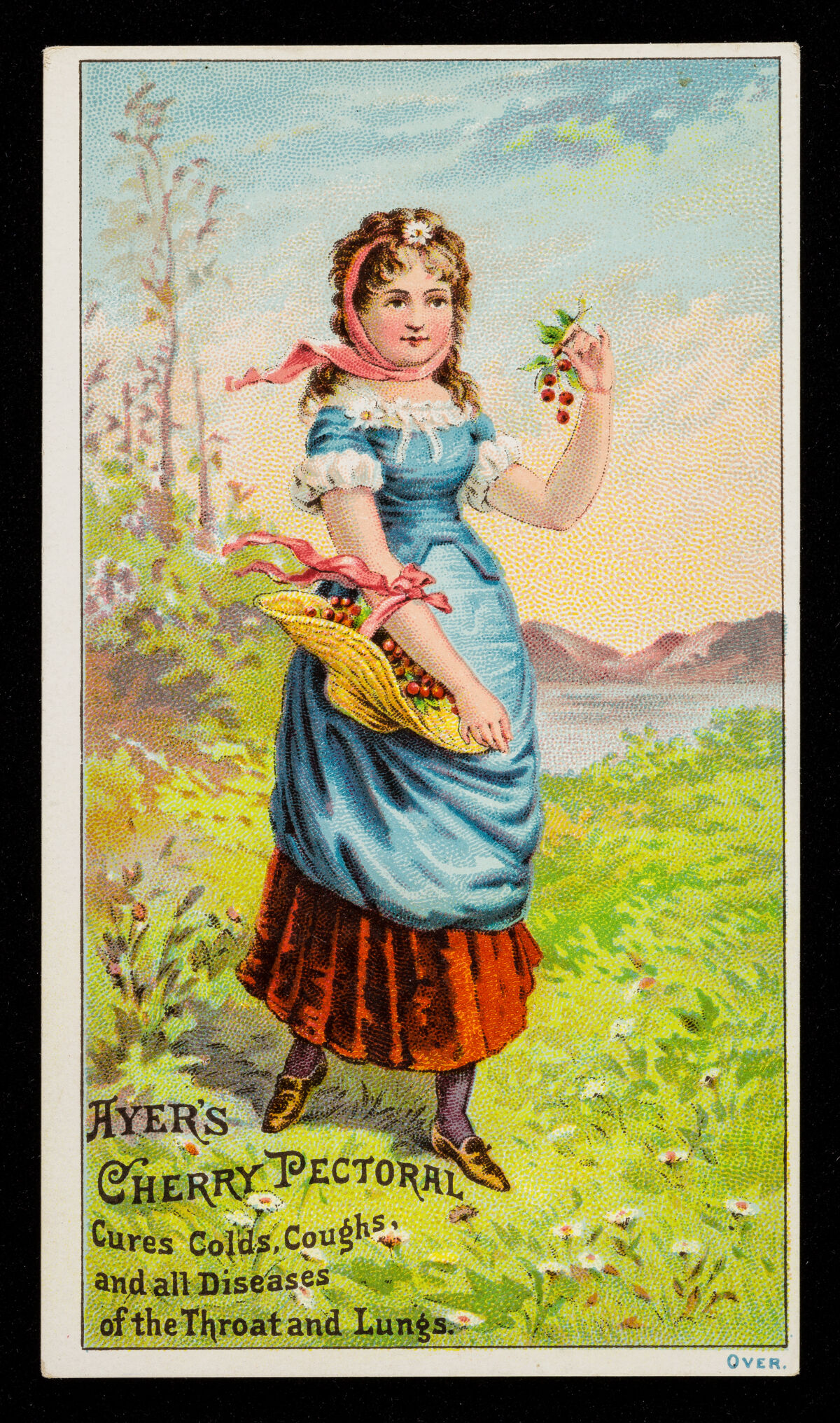 Ayer's Cherry Pectoral trade card (J.C. Ayer Co., Lowell, Mass., 1880s)Image hosted by Wellcome Collection - open the original ↗
10 The afterlife: a finite supply meets a thin market
Once the 2009 code took effect, nobody made genuine reminder items anymore, which is the whole basis of the collectible market. The American Institute of the History of Pharmacy put it plainly: the code "effectively ended" this style of promotion.42 Hospitals and clinics threw out a great deal at the time, and some of it went to thrift stores. Some of it went into collections. Allen F. Almquist, a retired Army colonel and pharmacist, has collected for about 45 years and owns "thousands" of pieces. His 2023 book, The Very Best in Drug Company Promotions... and then some, runs about 500 pages with more than 1,400 color photos.42 Cedars-Sinai cardiologist Jeffrey Caren reportedly owns more than 1,000 rep pens. Antique Trader notes that "many collectors are doctors."21 Institutions collect too: Duke, OHSU, the Smithsonian, the AIHP, a Philadelphia pharmacy museum holding Valium paperweights and Prozac golf towels, and Bristol's Glenside Museum in the UK.3433151105
On the seller side, the archetype is the thrift-store flipper. Antique Trader profiled an Ohio eBay seller of 19 years, @cosmicdealheather, who bought a bag of pens for $3 and posted on TikTok that they were "worth $100."21 That caption is a claim, not a sale, and the distinction is the most important thing in this section.
What sold, and what is merely hoped for
For the second version of this piece we went back through eBay browse pages, Etsy and individual listings in October 2026 and logged prices on 126 new directory entries. The result splits cleanly into two very different numbers.
Sold prices are low. The six-pen lot with Ativan and Coumadin went for $12.15 A set of Clarinex pens in sunburst, star and cartoon-bird holders, listed at $45, sold for $25 via best offer.152 The sealed OxyContin pen pair sold for $79.99, as reported by Antique Trader in 2025.21 (Both eBay sale dates show no year.) A Vyvanse acrylic paperweight was at $142.50 with five bids when we looked, with the auction still running, so it is neither an asking price nor a sale yet.153
Asking prices are high, at the top. The most ambitious listing we found is a 1993 Upjohn Xanax desk flip chart of diagnostic criteria for anxiety, panic, depression and substance abuse, at $450.154 A Du Pont Percocet/Percodan heat-change mug asks $355; whether it is the same "Pain" to "Relief" design STAT showed in 2016, the listing doesn't let us say.16110 An unused Xanax color-change mug on Etsy asks $350.155 A 1980s Vicodin ES beach towel, 51 by 28 inches, red banner, "May be habit forming" printed right on it, asks $345.156 Below those sit a Klonopin Wafers alarm clock at $200 with 135 watchers, a 2007 Vyvanse mug at $200, and an Upjohn Xanax heat-change mug marked down from $199.95 to $159.96.157158159
Asking prices are not a market. They are a seller's opinion, and a listing can sit at $450 indefinitely without anyone agreeing. The typical October 2026 asking bands are more useful: single-brand pens $5-20 (opioid-brand pens $20-30, sealed OxyContin pen lots $105-165), mugs $12-60 with Xanax, Vyvanse and Percocet as outliers, clocks $15-150, and 1960s-80s desk objects $10-125. Those bands are our own October 2026 log, not a published index. The gap between those bands and the verified sales - $12 for six pens, $25 for a Clarinex set - is the realistic discount between hope and money. The press-reported $79.99 OxyContin pair is still the best evidence that the premium brands really do sell above commodity pens. We have verified no sale above $200. That is partly because WorthPoint's sold prices are paywalled and eBay's sold-results pages wouldn't load for us, so the gap reflects our access, not proof that no such sale exists.
What sellers are asking, by object
Hope, plotted.
What drives value, according to sellers and the one trade article on the subject: material (metal over plastic), condition, sealed packaging, brand recognition and, above all, drug class.21 The new top listings fit that almost too neatly: two Xanax pieces, a Percocet, a Vicodin, a Klonopin, a Vyvanse. Every one is a benzodiazepine, an opioid or a stimulant. That is our reading of asking prices, which tell you what sellers believe buyers want, not a measured finding. In that top layer, cultural weight seems to matter more than rarity. A Lexapro calculator is not scarce. Forest Labs apparently made them by the case, and one listing offers a case of 50.160
Withdrawn drugs add another story. Merck's Vioxx clock, with a working pendulum, comes from a painkiller withdrawn in 2004.161 Wyeth's RotaShield vaccine was on the market for about a year in 1998-99, so its insulated mug can be dated to within about a year.162 Eli Lilly's Oraflex was marketed in the US only in 1982, so its copper-tone pill paperweight, asking $64.99, is one of the most tightly dated objects in the directory, whatever the seller's "1970s" title says.163 Whether buyers pay extra for a withdrawn-drug piece is untested.
Real swag, or did we make it up?
Ten objects. Some were handed to doctors. Some we invented. Every real one links to its source.
11 From reminder item to meme: opioid irony and SSRI identity
Making fun of doctors and their suppliers is older than the pens. A London etching from 1803 shows named physicians thanking the influenza epidemic for their business, and a lithograph from the camp of the pill-seller James Morison, around 1848, shows a hearse pulling away from a doctor's door.164165 The modern version runs on two separate currents, and it helps to keep them apart.
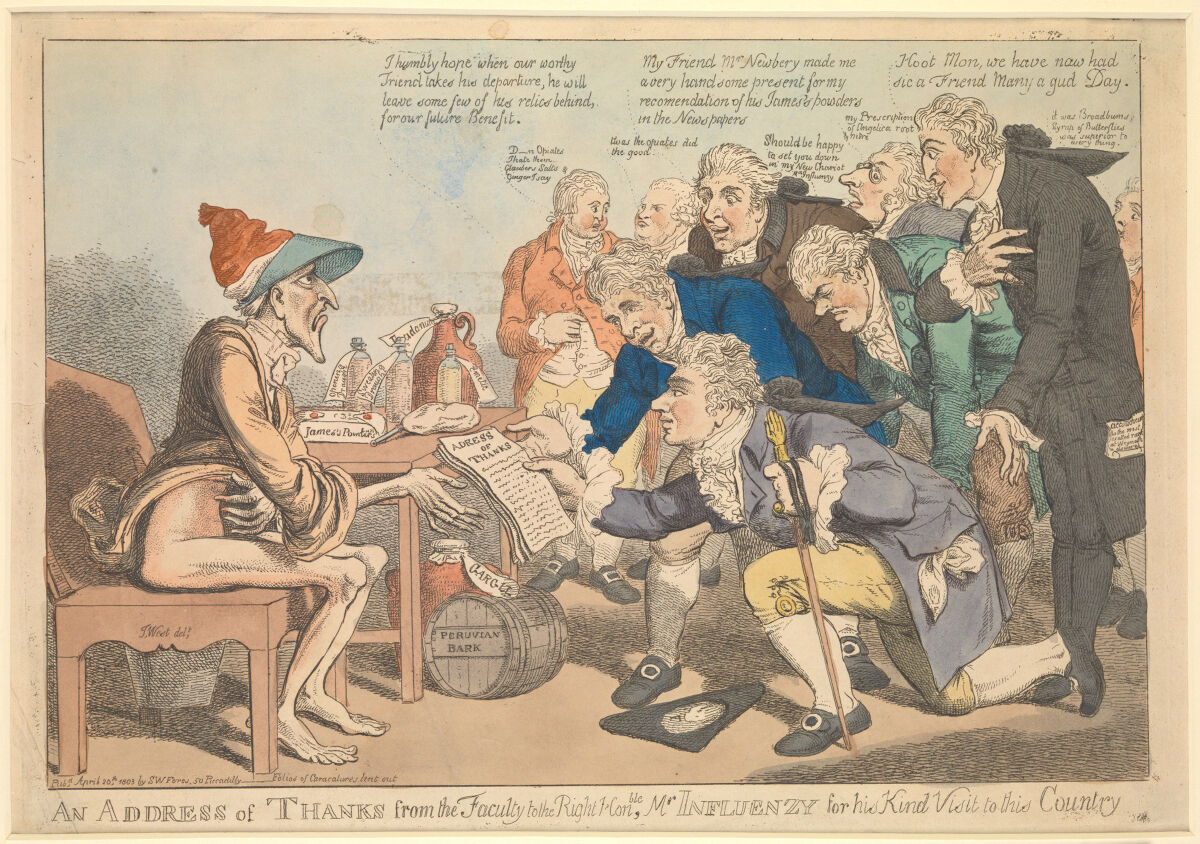 Physicians expressing their thanks to influenza (etching attributed to Temple West, 1803)Image hosted by Wellcome Collection - open the original ↗
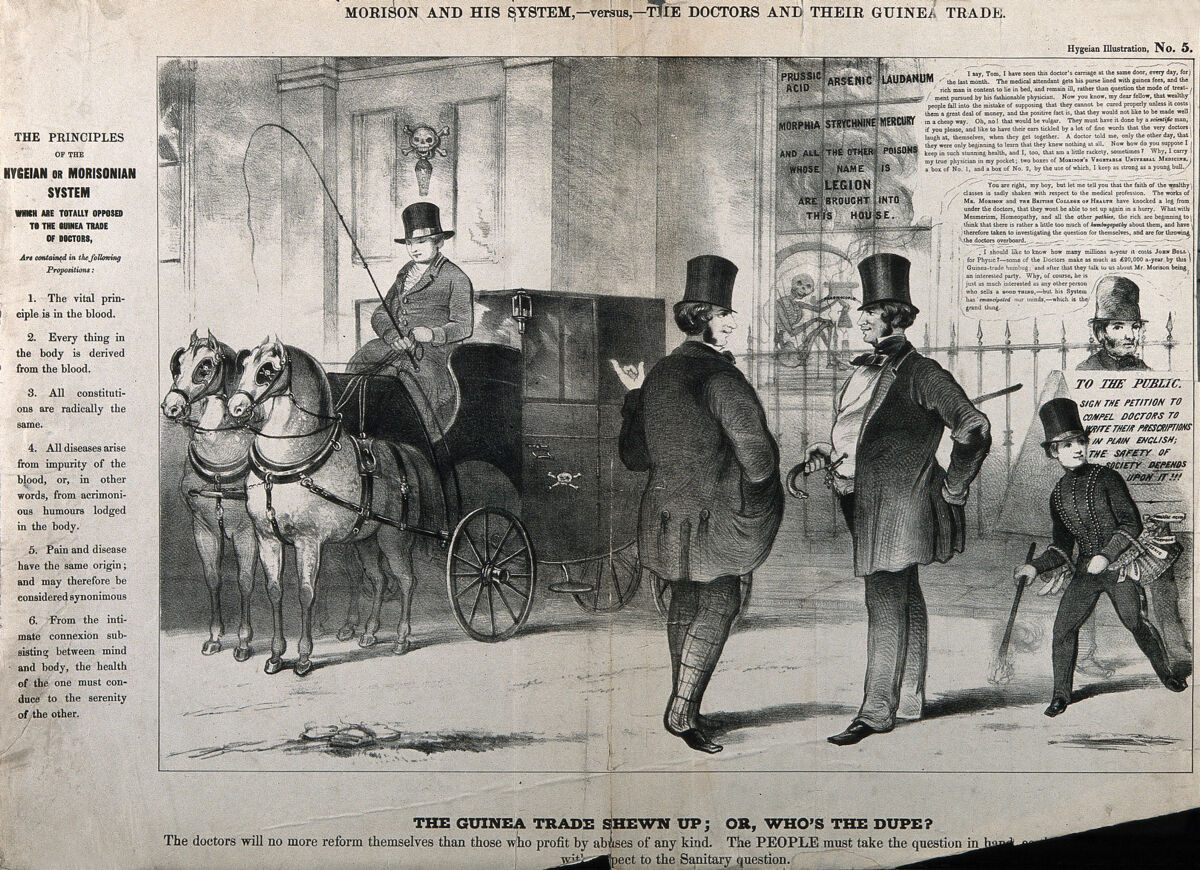 A horse-drawn hearse pulls away from a doctor's (lithograph, c.1848)Image hosted by Wellcome Collection - open the original ↗
The first is opioid irony, and its turning point was Oliver and STAT in October 2016.110108 After that, an OxyContin mug stopped reading as office clutter and started reading as a souvenir of documented corporate harm. Design press took the same tone. Core77's 2020 roundup called the items "thinly-veiled bribery attempts" and noted: "It seems hard to believe that tchotchkes like these led our country into an opioid epidemic." Its links went to live listings for a Vicodin candy jar and a Duragesic (fentanyl) pen-and-stapler set.166 Demand for the opioid pieces is, at least partly, demand for a punchline with a body count. That is uncomfortable, and probably accurate.
The second is SSRI identity culture, and it has nothing to do with harm. By 2023, Feed Me's Emily Sundberg was writing that "being depressed is now a status symbol." She pointed to podcaster Eileen Kelly's merch, which included sweatshirts reading "Lexapro," "Prozac" and "Zoloft."167 In 2025 the Wall Street Journal reported that antidepressants were being "recast as a hot lifestyle accessory" on TikTok and Instagram, with influencers discussing Lexapro openly and telehealth brands paying creators per post.168 The Zoloft blob had a pop-culture life of its own long before that. Its ads, directed and illustrated by Patrick Smith of Beavis and Butt-Head and Daria, drew parodies and a Family Guy cameo.169 Pharmacy Times called the blob "the most lovable mascot in the depression drug space."58 We found no sign of a 2020s blob revival.
We think the second current explains the Lexapro mug's $49.99 price and 13 watchers better than any scarcity argument. That is inference. The Antique Trader piece now confirms, from the seller side, that the category sells and which drug classes move; it says nothing about who the buyers are.21 No source we found connects the identity-merch wave to vintage rep swag directly, uses a "pharmacore" label, or documents a TikTok trend beyond that one reseller's post. The demand on Etsy is mostly for new goods: Xanax pill-graphic tees, a Xanax pill candle, Xanax bar soap.170 Different product, same vocabulary.
The vocabulary is simple enough to generate. Every reminder item followed the same template: a made-up-sounding brand, a strength, a slogan about relief, and an object that fit on a desk.
Make your own reminder item
Every blockbuster got a pen. Invent a drug and we'll print yours. Real brand names are refused - they already had their turn.
The legal side is mostly about those new goods. Reselling genuine used promotional items is generally understood to be lawful under the first-sale principle (general background, not something our sources address for pharma). Printing a drug trademark on a new mug is riskier. Drug makers enforce their marks, and Pfizer once got a court to stop a man from driving a 25-foot "Viva Viagra" missile around Manhattan.171 We found no case of a company pursuing vintage swag resellers.
12 How to read a listing: a buyer's field guide
None of what follows comes from a published authentication guide, because we couldn't find one. It is practical inference from the sources above, and we have labeled it that way.
Check the brand's dates against the gift era. Genuine US rep swag comes from before 2009. A brand that launched after the ban can't have authentic gift-era reminder items, so treat any such piece as either educational material or a modern novelty. The launch date sets the earliest possible date. A co-branded Lipitor/Caduet pen can't predate Caduet, and a "Partners Against Pain" OxyContin/OxyIR pen can't predate OxyContin. Withdrawn drugs (Vioxx, Bextra, Zelnorm, RotaShield, Oraflex) set a latest date too.
Distrust the decade in the title. Sellers date by feel. Our own directory pass caught several: an Oraflex paperweight titled "1970s" for a drug sold only in 1982, a Welchol wall clock titled "90s" for a drug approved in 2000, and a pair of Topamax earbuds that may postdate the 2009 ban entirely.163172173 The 1988 Tagamet "TLC" pill case and the 1993 Xanax flip chart both carry "Made in China" captions in their listings.174154 That doesn't make them fake - plenty of promo goods were made in China in 1993 - but it is a detail worth asking about at $450.
Read "Brand New" two ways. It can be honest new-old stock: genuine lots of never-distributed pens are routinely listed as "New."20 It can also be a modern print. The muddle is real. One eBay drug-advertising mug is listed as condition "New" with the item specifics "Vintage: Yes" and "Original/Licensed Reproduction: Licensed Reproduction" filled in at the same time.175 For the Xanax-Lexapro-Ultram lot, the title alone can't settle it. Ask for photos of the base or backstamp, any promo-supplier imprint, and original packaging or sleeves. Then compare the artwork with period branding. Gift-era items often carried the generic name, the strength or dosing copy. The Risperdal Swiss Army card at Glenside includes dosing information, for example.105
Look for the generic name and clinical text. Many genuine pieces print the generic in parentheses, as in "Ultram ER (tramadol)" or "Feldene (PIROXICAM)," or a regulatory phrase like "Morphine Sulfate CII."51 The Vicodin ES towel prints "hydrocodone bitartrate 7.5mg" and "May be habit forming."156 Novelty sellers rarely bother with any of it. The Xanax "Panic Attacks... Heat Reactive" mug title is an example of period indication copy surviving into a listing.176 This is a useful signal, not proof.
Price the class, not the adjective. Every other listing says "rare." Generic pens are commodities ($12 for six, sold).15 Treat $80 for a sealed OxyContin pair as a real data point and $450 for a flip chart as an opening position.21 Watchers are interest, not sales.
Watch for non-US pieces. Some "vintage" items are European or Australian. The directory flags one Claritin pen marked Germany. Foreign-market brand names, like Lustral for sertraline in the UK, are a giveaway.105 So are UK items dated after 2011, when the ABPI ban took effect there.99
Separate the press-documented from the listed. A few items are confirmed by journalism, government reports or museum catalogues: the GAO's OxyContin list, STAT's Oliver haul, the Ignarro tie, the Premarin openers, the Smithsonian drawer. Most of the market is seller titles. That is fine for a $20 pen, but at $200 you want provenance.
13 The directory: about 440 pieces, mostly pens, mostly self-described
The companion directory now merges three research passes into about 440 entries: the 293 from our first version and 147 new ones from an October 2026 pass, none of which repeats a source URL or listing ID already in the set. Every row is graded on one of three levels. Press-documented (about 50) means a journalist, a government report, a museum catalogue or a collector history describes the item. Listing opened (about 55) means we loaded the page and read the description. Listing title only (about 340) means the item is known from a seller's eBay, WorthPoint, Etsy or PicClick title in a search index, and the page itself wouldn't load. So roughly three-quarters of the directory is seller-described and unverified, and old eBay links expire. It is a map of what has appeared on the market, not an authentication service.
The directory: 440 documented pieces
Filter by drug class, object or how solid the evidence is. Search takes brand, generic, maker or design words.
Psychiatric, cardio/metabolic and pain/opioid brands still lead. The new pass added about 90 brands, filling in names we missed the first time - Glucophage XR, Avodart, Clarinex, Cipro (a pen, a mug, a laser pointer and IV pens), Tamiflu, Epogen, Neurontin, Topamax, Zomig, Rozerem, Restoril, Avinza - and reached further back, into the desk-object era: the Thorazine ruler and blotter, the Diuril "Visible Man," an Orinase sundial paperweight, a Preludin Lucite block, Darvon Compound-65 and Darvocet-N display jars, an Inderal seal-cutter, a Feldene reflex hammer, a Seldane-D note cube and a Hismanal mug.5017751 The older material survives mostly as paperweights, rulers and display jars; pens and mugs are mostly 1990s-2000s. That describes what survived, not what was made.
The standouts, for anyone browsing: the 1995 OxyContin plush pill with its misspelled warning banner,45 the Ignarro Viagra tie,41 the Premarin tablet letter opener,42 the Lamisil Digger bobblehead card holder,54 the 2001 two-sided Zoloft blob shirt,61 the Nexium purple-pill thermos,44 the Cozaar/Hyzaar "TAKE IT DOWN" cuff set,46 the Ultram ER alarm clock,178 the Prevacid stomach plush,48 Tagamet Tommy,32 EneMan,56 the Pfizer COSA dragon ashtray,32 the Xanax flip chart154 and the Vicodin ES towel.156 Coverage is still thin or empty for Zocor, Lasix, Flovent, Accutane, Yaz, Bactrim, Xenical, Meridia, Lamictal, Soma and the mid-century tranquilizers (Miltown, Equanil, Librium, Seconal). Searches for those returned print ads, bottles and fan merchandise. A missing brand means we didn't find it, not that the brand made no swag.
14 Open questions
Some of the questions in our first version are now closed. Massachusetts's law is Chapter 305 of the Acts of 2008, the pen language is in 105 CMR 970.008, and the dates are firm.1213 The Sunshine Act is ACA section 6002 with indexed thresholds.9495 EFPIA's ban did take effect on January 1, 2014, the UK's in 2011 and IFPMA's in 2019.10099103 No Free Lunch's pen amnesty worked as described above.79 And there is pre-1960 object evidence: 1940s blotters, Upjohn detail men's catalogs, the COSA ashtray, the Laennec replica.28303231 These remain open.
The Zoloft blob plush. Still unconfirmed after two more rounds of searching. The only verified blob merchandise is a 2001 T-shirt.61 Fan-made pill plush is easy to find, and it is not the same thing.59
The OxyContin CD title. Narrowed but not closed. Van Zee's slides give slogans, not a title, and his 2009 paper's full text was blocked again.112113
The early American history. We now have objects, but no count of detail men or a history of their giveaways before 1960. Podolsky and Greene's 2008 JAMA history is the obvious next read; we located it but could not open it.179
Whether pens alone change prescribing. The attitude evidence exists82 and the meal evidence exists.83 A study linking trinkets alone to prescribing outcomes doesn't.
The high end of the market. Asking prices now reach $450, but we have verified no sale above $200, because WorthPoint and eBay sold data were out of reach. We also couldn't identify collector clubs, forums or dedicated Instagram accounts.
The irony-buyer thesis. A reseller confirms the category sells; nobody has documented who is buying, or why.
Massachusetts enforcement and money. We found no fine ever issued under c.111N, the two counts of the first disclosure (161 vs 283 companies) remain unreconciled, and the final Massachusetts share of the Purdue settlement is unconfirmed.127128140
Canada. We could not find when Canadian industry codes first banned branded reminder items.
Directory accuracy. Approval years and manufacturer attributions came from general reference, not per-row citations. A few seller attributions conflict with known marketers - a Protonix clock credited to Janssen, a Pepcid hammer credited to McNeil - and several seller-supplied decades are demonstrably wrong.
15 Conclusion
The odd lesson of pharma swag is that the cheapest part of the marketing machine left the deepest cultural mark. Samples and detailing cost tens of billions, and nobody collects them. The $630 million worth of pens and mugs, ruled out largely because they "may foster misperceptions," turned into the era's physical record: a museum tie, a Smithsonian drawer, a GAO exhibit list, a punchline on HBO. Boston adds a twist to that record. It is the place where the pen was written into a regulation by name, and also the place where the state's own lawsuit showed what replaced it: 150,000 visits, coffee and catered lunches, no logo required. The trinkets were banned. The access they bought was not.
What sets the prices now is less about the objects than about what each brand stands for. OxyContin sells as evidence, Xanax and Vicodin as dark kitsch, Lexapro and Zoloft as identity, and Viagra as a joke that still works. The verified market is small and cheap - $12 for six pens - while the asking market tells you what people think these names are worth as stories. A buyer looking at that four-pen lot isn't paying for four pens. They're paying for a benzodiazepine, an opioid and two antidepressants from the years when companies could still print those names on office supplies. Goodman's pen amnesty offered doctors a trade: a drug pen for a pen that said no. Twenty years later, the drug pens are the ones people want.
Directory: about 440 entries (293 from the first version plus 147 added October 2026). Confidence levels, approximately: press-documented 50, listing opened 55, listing title only 340. Prices are asking prices unless marked sold, collected October 2026.